
Saginaw Parole and Probation Compared
Parole and probation both place a person under rules in the community, but they begin in different ways. A parolee has physically left a Michigan prison and remains in the legal custody of the Michigan Department of Corrections, or MDOC. Probation is a court-ordered community sentence. It can follow a jail term, but it can also be imposed without a state-prison term. An OTIS label of “Probationer” therefore does not prove that the person was released from prison.
The key is to read the exact current status. “Parolee” confirms a prison exit into supervision. “Probationer” confirms an active probation case under MDOC field supervision. “Discharged” means active MDOC jurisdiction has ended for the sentence shown. These labels should not be replaced with a broad claim that someone is simply free or still confined.
| Record point | Parole | Probation |
|---|---|---|
| How it begins | Physical release from state prison after Board action | Court imposes a community sentence, with or without a jail term |
| Public OTIS label | Parolee | Probationer |
| Saginaw contact | County Parole Office on Treanor Street | County Probation Office on Cass Street |
| What it does not prove | Final discharge from MDOC | A prior prison release |
- Parole
- Release from prison into MDOC legal custody and field supervision.
- Probation
- A community sentence supervised under a court order.
- Discharge
- The end of MDOC jurisdiction for the sentence or supervision term shown.
- Absconder
- A supervised person reported for failing to remain in contact as required.
Check Saginaw Post-Release Supervision
The official starting point is Michigan’s Offender Tracking Information System, known as OTIS. It covers prisoners, parolees, probationers, interstate supervision cases, absconders, and people discharged from MDOC within the public display period. It does not cover a person whose only sentence was in the Saginaw County Jail. Use the six-digit MDOC number when known. A name search can be narrowed by age, sex, race, and status.
- Search by MDOC number, or enter the full first and last name.
- Use the Parolees or Probationers status filter to narrow the results.
- Open the matching profile and compare the MDOC number, identifiers, county, court file, offense, and sentence date.
- Read Current Status and Assigned Location before calling an office.
- Contact the Saginaw office that matches the status and quote the label exactly.
- For proof that supervision ended, look for Discharged and the sentence-level discharge date or obtain the official record.
The official OTIS definitions explain the status and date labels shown in profiles. A result may also list active and inactive prison or probation sentences, a Maximum Discharge Date, and supervision conditions. A missing field is not a zero value. Record only what the profile displays.
The image below comes from the official MDOC status definitions used to interpret Saginaw County parole and probation records.
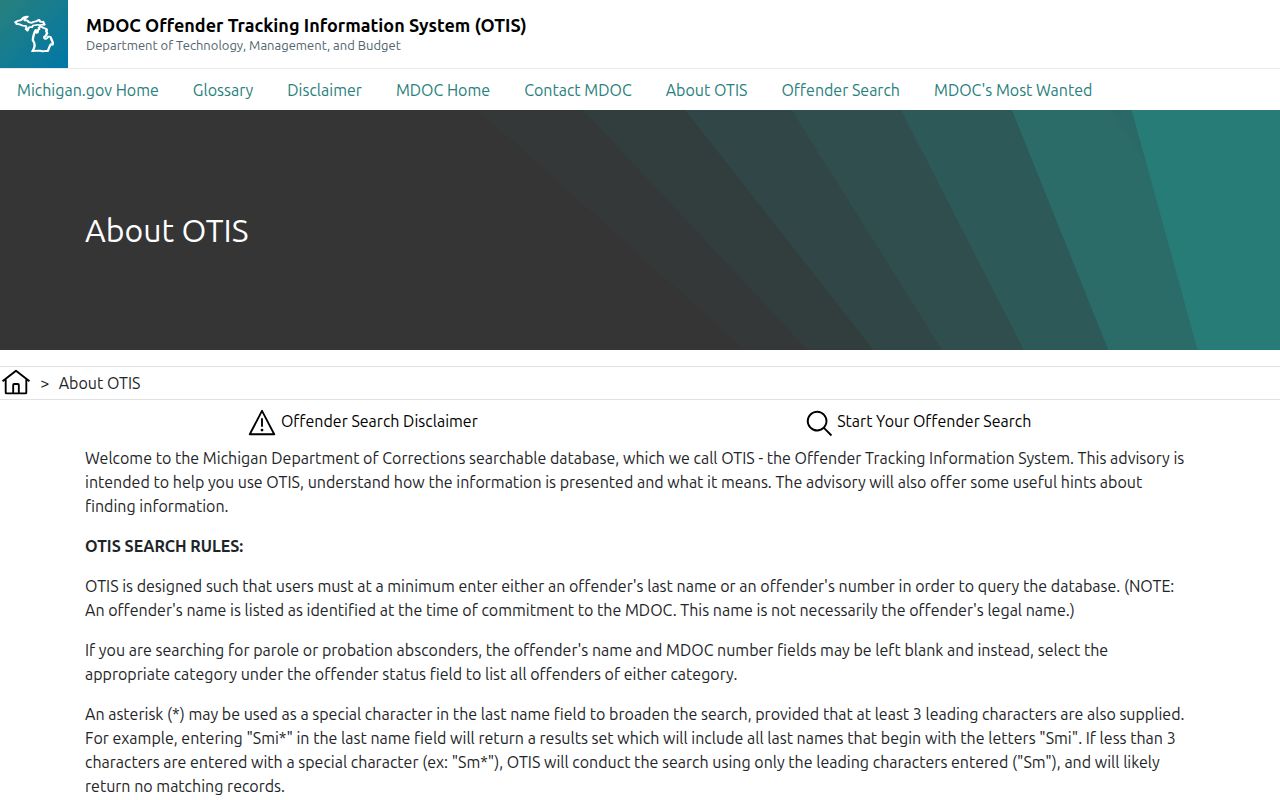
Those definitions keep a current status, a prison release date, and final discharge from being mistaken for one event.
Saginaw Supervision Offices Stay Separate
Saginaw County has two distinct field locations. This makes the OTIS status more than a label. It determines which local office can address an active supervision question. Calling a general state counter first can add delay, while the Region 5 directory gives a direct local route for each status.
Saginaw County Parole Office
1835 Treanor StreetSaginaw, MI 48601
Phone: 989-754-8661
Saginaw County Probation Office
618 Cass StreetSaginaw, MI 48602
Phone: 989-758-2470
Start with the MDOC Region 5 office directory when contact details need to be checked. Ask about the status that OTIS displays, not a guessed status. An Assigned Location is the responsible field office in the record. It is not proof of the person’s present street location.
The official Region 5 directory shows both Saginaw field offices and their separate contact routes.
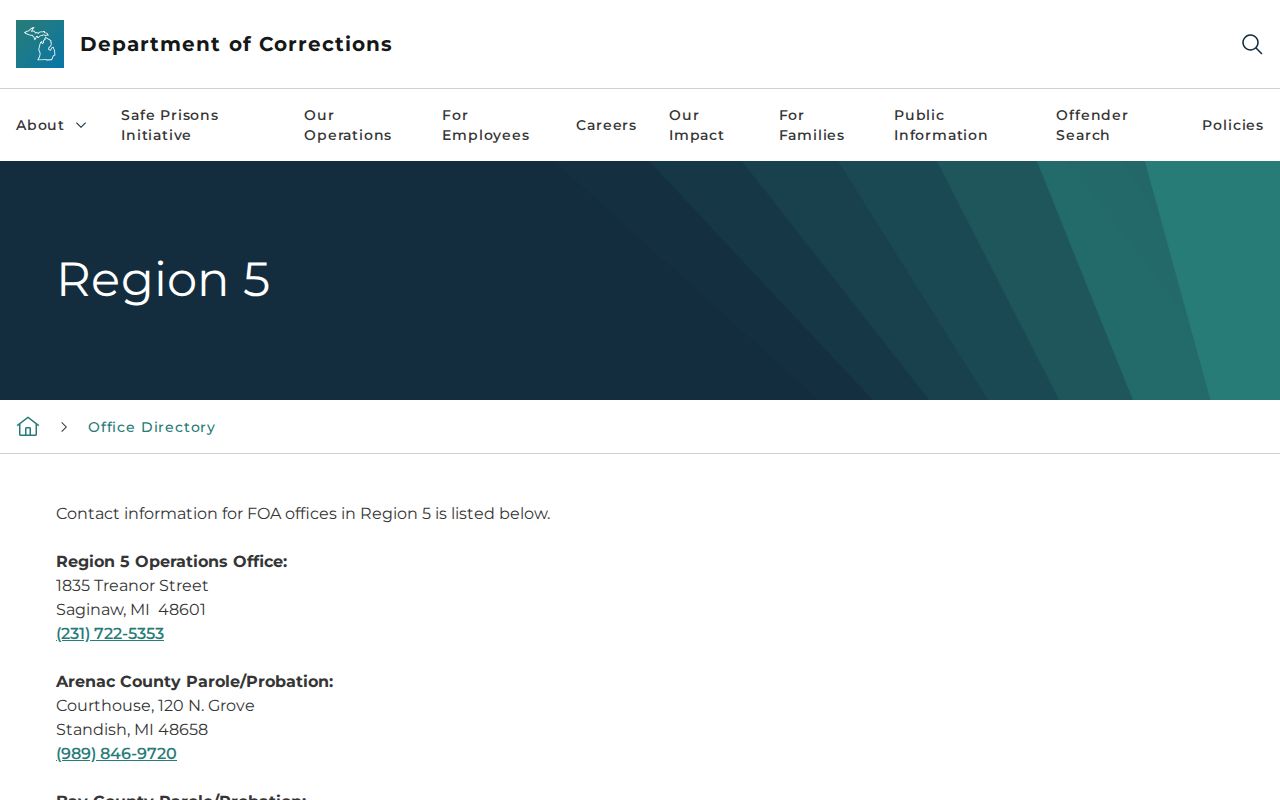
The split reinforces a simple workflow: identify Parolee or Probationer in OTIS, then call the matching Saginaw office.
Saginaw Release and Reentry Layers
Saginaw has two local programs that can look similar in a quick search but serve different stages. Saginaw Community Corrections operates Pretrial Services, day reporting, electronic monitoring, and TRI-CAP. Those services can relate to a local court case or community status. They do not prove a state-prison parole or final discharge.
Saginaw Correctional Facility is different. MDOC identifies that state prison as a ReEntry In-Reach facility. In-reach is prerelease planning inside the state system. It does not mean that every participant has been paroled, and it does not set the final discharge date. After physical release, an OTIS Parolee status and the Saginaw County Parole Office provide the public supervision trail.
This distinction matters when a court record shows bond conditions. Release on bond is a physical exit while the case remains pending. It is neither probation completion nor parole. The broader release and record trail is addressed through the Saginaw County released-inmate search when the holding system is not yet clear.
Saginaw Absconder and Warrant Status
OTIS separates Parole Absconders from Probation Absconders. The distinction changes both the authority and the meaning of the result. The MDOC code ABSCOND1 describes a parole absconder actively sought after a failure to report. ABSCOND2 identifies a probation absconder under the sentencing county’s jurisdiction. The OTIS Most Wanted and absconder search can be checked alongside the main profile. Under MCL 791.238, an absconding parolee may be returned on a warrant and face the unexpired maximum term. A probation matter follows the sentencing court and county route. The supervising office shown is the last assigned office, not a live location for the person. In either case, being outside prison is not successful discharge.
The official absconder interface illustrates the separate parole and probation paths used for Saginaw supervision records.
Read the result as an active supervision and warrant signal, then use the responsible agency named by the status.
Note: A transfer, missed report, warrant, and final discharge are distinct events; the exact OTIS label should be preserved.
Correct Saginaw Supervision Records
OTIS uses a split correction route. A mistake drawn from the judgment, sentence, conviction, or other court material should be taken to the sentencing court. MDOC does not rewrite the court’s order on a caller’s statement. It updates court-derived information when the proper court order directs a change.
A supervision, assigned-office, or absconder issue follows a different path. Contact the parole or probation office tied to the current status. The supervising agent can direct an MDOC correction when warranted. In Saginaw, that means Treanor Street for parole and Cass Street for probation. Keep a copy of the profile, note the check date, and identify the exact field at issue. That is more useful than saying the whole record is wrong.
Older public records have another limit. OTIS generally displays a person discharged from MDOC for three years after the latest discharge. A no-result after that period can be a display-retention effect. It does not establish that no prior state supervision existed.
Saginaw Parole Board Record Trail
The Michigan Parole Board is the sole paroling authority for felony prisoners committed to MDOC. Reaching the minimum term or Earliest Release Date gives the Board jurisdiction to consider parole. It does not create a right to leave prison. A favorable decision is followed by release planning and may still be suspended or rescinded if new adverse information or misconduct appears before release.
Michigan does not publish one complete calendar for all routine parole interviews, nor does it offer a public named-person database of every decision. Public hearings appear as event-driven MDOC press releases. Aggregate grant, deny, and defer data appears in quarterly legislative reports, but those totals cannot verify one person’s outcome.
For a named Saginaw case, use OTIS status and dates, an authorized notice, or a releasable Parole Board order. A denial sets another review point rather than a release. A grant is also not the Date Paroled until physical release has occurred. MCL 791.233 supplies the parole standard, while MCL 791.234 addresses Board jurisdiction and eligibility.
When Saginaw Supervision Ends
Final discharge is the key end point. For a parole case, Date Paroled marks physical release from prison and the start of community supervision. Discharge Date marks the later end of MDOC jurisdiction. A Maximum Discharge Date is a potential endpoint under the sentence. It should not be treated as proof that supervision already ended.
Probation also ends through an order or recorded discharge, not merely because a date was expected. Check the current OTIS status and each sentence block. One sentence may be inactive while another remains active. When exact legal proof is needed, request the discharge or termination record from MDOC or obtain the controlling court order.
MI-VINE can send custody-change notices for participating jails and MDOC, but it is not the source of a final supervision certificate. A release alert can coexist with parole or probation. The separate meanings of Earliest Release Date, Date Paroled, Maximum Discharge Date, and Discharge Date are also explained on the Saginaw County projected release page.