
Match Saginaw Release Date Systems
A projected date is an estimate or legal milestone. An actual date records an event that occurred. The two can match, but a public field should never be described as an actual release until the custody record changes. Start by identifying the holding authority. Saginaw County Jail, Saginaw Correctional Facility, another MDOC prison, and a federal facility use different records.
A person held before trial at the county jail does not yet have a sentence-based release date. A bond order may authorize release after its conditions are met, but another warrant or detainer can keep the person in custody. A detainer is a request or legal basis for another authority to take or continue custody. A transfer to MDOC, another jail, or federal custody is also not community release.
A sentenced state prisoner has an indeterminate sentence in the usual Michigan model. That sentence has a judicial minimum and a statutory maximum. The minimum can bring the case within Parole Board jurisdiction. It is not an appointment to leave. The maximum can mark a possible no-parole endpoint, but the profile must show the later status before it becomes proof of what happened.
Find Saginaw Projected Release Records
The Michigan Offender Tracking Information System, or OTIS, is the public route for a state prisoner. It includes people in prison, on parole, on probation, and discharged from MDOC within its display period. OTIS expressly excludes county-jail and city-lockup prisoners and people whose only sentence was jail. A Saginaw County Jail sentence will not appear just because the jail is in Michigan.
- Search with the six-digit MDOC offender number when it is known.
- Otherwise enter the first and last name, then narrow carefully by age, sex, race, or status.
- Open the matching profile and compare identifiers, county, court file, offense, and sentence date.
- Read each sentence block and copy the exact date label, not just the date.
- Check Current Status to learn whether the person is a Prisoner, Parolee, Probationer, or Discharged.
- Confirm a past physical release through Date Paroled or the official MDOC order when exact proof is required.
Search fields include last name, first name, MDOC number, sex, race, age, status, and marks, scars, or tattoos. The cleanest match uses the MDOC number. Name-only matches should be checked against the court file, sentencing county, physical identifiers, and offense information.
| OTIS field | What it means |
|---|---|
| Earliest Release Date | Earliest point of Parole Board jurisdiction or consideration, not a promised exit |
| Date Paroled | Historical date when physical prison release to parole began |
| Maximum Discharge Date | Potential sentence endpoint if parole does not occur, subject to lawful calculations |
| Discharge Date | Historical end of MDOC jurisdiction for the sentence shown |
| Current Status | Present public category, such as Prisoner, Parolee, Probationer, or Discharged |
The official OTIS date and status definitions are shown in the successful source capture below.
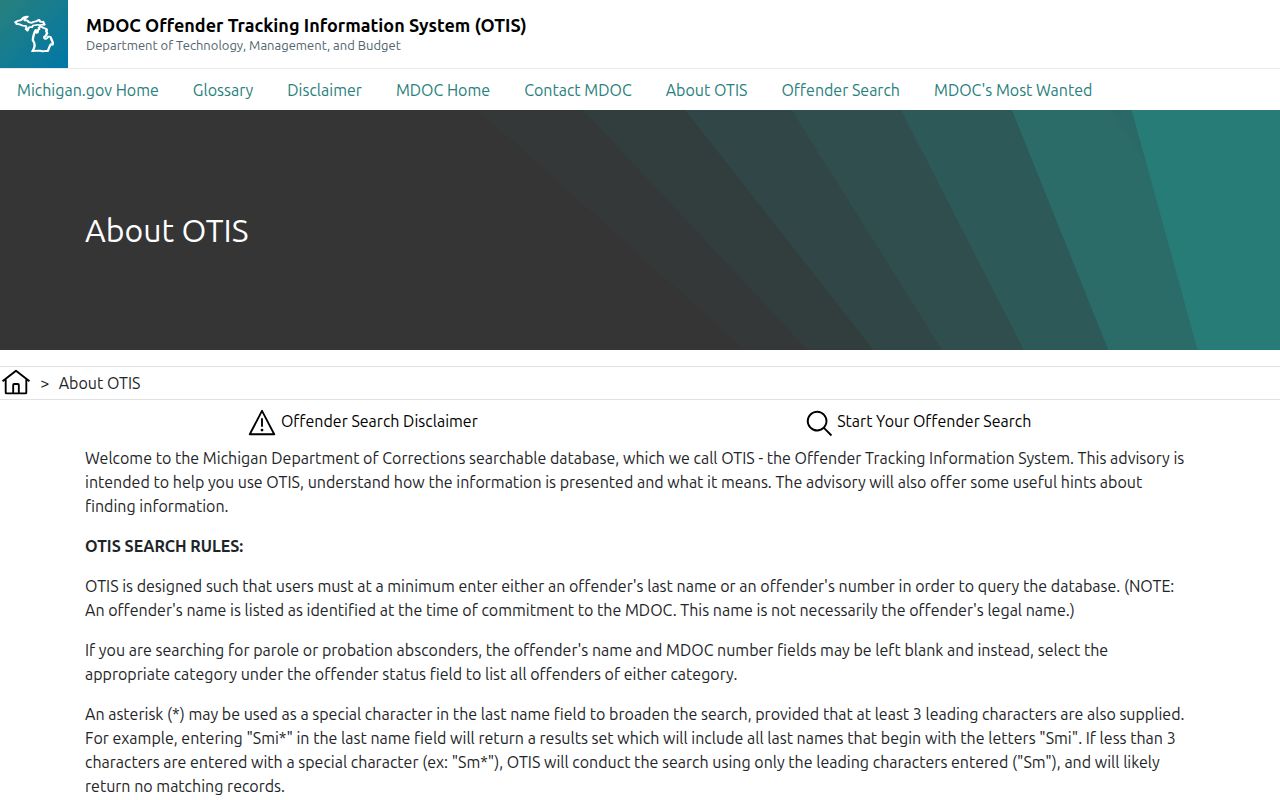
The definitions show why Earliest Release Date, Date Paroled, Maximum Discharge Date, and Discharge Date cannot be collapsed into one answer.
Saginaw Release Dates Are Not 85%
Michigan is not an “85% state.” That shortcut is inaccurate for the modern state-prison framework. For covered truth-in-sentencing offenses, a prisoner must serve 100% of the judicial minimum term in prison before parole consideration. Specified assaultive offenses committed on or after December 15, 1998, and other covered offenses committed on or after December 15, 2000, fall within this framework. Truth in sentencing removed good-time and disciplinary-credit reductions from the minimum for covered modern terms. Class I misconduct instead produces disciplinary time that the Parole Board may consider. Reaching the full minimum places the person at the eligibility or jurisdiction point. The Board may grant parole, deny it, or consider release later under the governing law and record.
The MDOC truth-in-sentencing explanation is the source for the modern minimum-service rule.
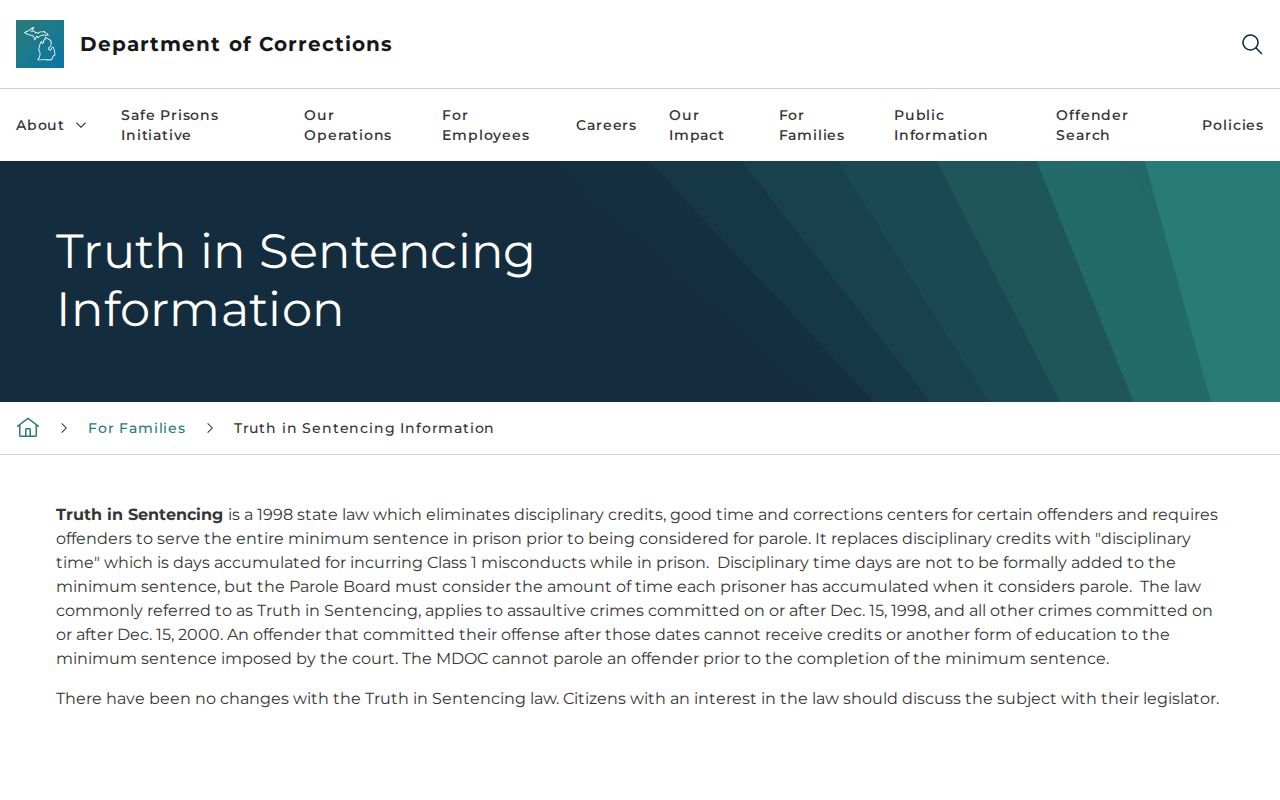
The state explanation supports a full-minimum rule, not a general claim that every Michigan prisoner serves 85% of a term.
Note: The offense date and governing sentence law must be checked before any credit rule is applied to a Saginaw case.
Legacy Saginaw Release Date Credits
Older Michigan sentences may use date-sensitive credits. For eligible crimes before April 1, 1987, good time generally ranges from five to fifteen days per month based on sentence length. Special good time may add half the regular award. MCL 800.33 contains the detailed rules and forfeiture provisions, so the case date and sentence record control.
For eligible offenses from April 1, 1987 through the relevant truth-in-sentencing cutoff, disciplinary credits generally provide five days per month plus as many as two added days for exceptional behavior. The maximum is commonly described as 84 days per year. Major misconduct can remove a monthly credit, and more forfeiture can apply. MCL 800.34 addresses disciplinary time, while MCL 791.234 governs when the Parole Board obtains jurisdiction.
Credits are not a simple percentage to subtract from the maximum. Consecutive sentences, restored or forfeited legacy credits, jail credit, and sentence amendments all affect the calculation. OTIS itself warns that projected information may not reflect the latest update. The official time review or corrected judgment is stronger when a close date matters.
Why Saginaw Release Dates Change
A date may move because the legal inputs change, the sentence is recalculated, or a separate authority blocks physical release. Some changes affect the eligibility date. Others leave the sentence date in place but change when or where the person physically departs. The record should identify which kind of change occurred.
| Factor | Possible effect | Best record to check |
|---|---|---|
| Misconduct or legacy-credit forfeiture | Changes a credit-based calculation or weighs in parole review | OTIS profile and MDOC time review |
| Restored legacy credits | May revise an eligible older sentence calculation | MDOC sentence record |
| Amended judgment or resentencing | Changes a court-supplied sentence input | Sentencing court order and corrected OTIS entry |
| Consecutive sentences or jail credit | Changes how terms and prior custody time are applied | Judgment and MDOC computation |
| Parole grant, denial, or deferment | Changes whether release follows eligibility and when review occurs again | Board order and OTIS status |
| Detainer, warrant, or other hold | Can prevent community release or cause a transfer | Holding agency and court record |
| Release processing and placement | Creates time between a favorable decision and physical departure | MDOC release record and Date Paroled |
A positive parole decision is not the same as Date Paroled. MDOC describes an ordinary minimum 28-day period from the decision to physical release for placement and processing. The grant can also be suspended or rescinded before release if misconduct or adverse information arises.
Saginaw Jail Release Date Limits
County-jail calculations do not use the OTIS Earliest Release Date. For a sentenced person at Saginaw County Jail, the court’s judgment, jail credit, lawful local calculation, and any applicable rule control. No official Saginaw source was found that publishes a local good-time formula, a weekend-forward policy, or a rule that a Sunday release occurs on Friday.
Do not fill that gap with a state-prison formula. Ask the Jail Shift Commander at 989-790-5432 whether the person is still held and which record documents the expected or completed event. Sheriff Administration can be reached at 989-790-5400. The automated number printed on the jail page is (859) 547-0404, but its area code conflicts with official local contacts and should be verified before use.
For a sentenced county-jail term, request the existing time calculation, incarceration record, or inmate-release form. Michigan’s GS11 schedule identifies release forms, sentencing information, bonds, transfer-to-prison material, and related jail-jacket records. A release form can distinguish community release from transfer. The broader Saginaw County release-record process explains the county request channel.
Saginaw Parole Dates Need Board Action
The Michigan Parole Board is the sole paroling authority for felony prisoners committed to MDOC. MCL 791.234 sets the jurisdiction framework. MCL 791.233 supplies the release standard. Serving the minimum or reaching the Earliest Release Date allows consideration, but the Board must still make the required finding before parole can occur.
A Board decision can grant, deny, or defer release. A denial results in another review point rather than physical release. Public hearings appear event by event in MDOC press releases, and not all parole hearings are public. Quarterly legislative reports summarize grant, deny, and defer outcomes, but they are not a named-person decision search.
For one Saginaw sentence, use the OTIS profile, an authorized notice, or a releasable Parole Board order. A Maximum Discharge Date remains the potential no-parole endpoint. A person can also be released on parole well before final discharge, which is why the date fields must be kept apart.
Confirm Saginaw Actual Release Dates
Once release has occurred, stop using a projection as proof. For state prison, Date Paroled is the strongest public OTIS field for the physical exit into parole. Current Status “Parolee” confirms that the person is outside prison under MDOC supervision. Final Discharge Date answers a later question: when MDOC jurisdiction ended.
A person who reaches Maximum Discharge without parole may leave at that endpoint, but the historical record still controls. When exact legal proof is required, request the Certificate of Discharge or Termination of Sentence, Parole Board order, discharge checklist, or Time Review and Disposition record from MDOC. OTIS public profiles may be incomplete and generally age out three years after the latest discharge.
For a future custody change, MI-VINE release notifications can provide an alert when a participating jail or MDOC reports release, transfer, escape, death, or another supported event. Read the exact alert. A transfer is continued custody, and a release alert is not a final discharge certificate.
- ERD
- Earliest Release Date, the earliest parole-jurisdiction point shown by OTIS.
- Parole
- Physical prison release into MDOC field supervision.
- Maximum discharge
- A potential endpoint at the maximum term, subject to the lawful sentence calculation.
- Final discharge
- The recorded end of MDOC jurisdiction, which may occur after parole.
Note: Record the field label, status, source, and check time so an eligibility date is never reported as a completed release.