
Saginaw Correctional Release Paths
Saginaw Correctional Facility, commonly identified by the code SRF, is a Michigan Department of Corrections prison. It is not operated by the county Sheriff. MDOC houses adult men there at security Levels I, II, and IV. The state opened the prison in 1993 and designates it as a ReEntry In-Reach facility.
Leaving SRF can mean transfer to another MDOC prison, parole into community supervision, release at maximum discharge, a court-ordered movement, medical or legal movement, or death. A transfer is continued confinement. Parole is a physical prison exit, but MDOC legal custody continues. Final discharge ends MDOC jurisdiction and may come much later.
- Transfer
- Movement to another secure MDOC setting, not release.
- Parole
- Physical release from prison into MDOC field supervision.
- Maximum discharge
- The potential sentence endpoint when no earlier parole controls.
- Final discharge
- The end of MDOC jurisdiction over the sentence.
Search Saginaw Correctional Releases
The Michigan OTIS offender search is the main public route. Search by the six-digit MDOC number when known. Otherwise, use last and first name, then narrow by age, sex, race, or status. Compare the county, court file, offense, sentence date, physical details, and identifier before choosing a record.
- Open OTIS and enter the MDOC number or the person's full name.
- Use a status filter such as Prisoners, Parolees, Probationers, Discharged, or All.
- Open the matching profile and confirm the identity and Saginaw sentence or assigned location.
- Read Current Status, Assigned Location, Date Paroled, Earliest Release Date, Maximum Discharge Date, and Discharge Date separately.
- For active supervision, call the field office that matches the displayed parole or probation status.
- For older or certified proof, request the release or discharge record from MDOC FOIA.
A profile can show a past prison location without proving the person was released directly from that location. MDOC may transfer a prisoner before parole. The status and date fields, along with the underlying order, provide stronger evidence than facility name alone.
Saginaw Correctional Date Meanings
OTIS uses several date labels that answer different questions. Earliest Release Date is the point when the Michigan Parole Board may obtain jurisdiction to consider parole. It is not a promised exit. Maximum Discharge Date is a potential no-parole endpoint, subject to the lawful sentence calculation. Date Paroled records the physical departure from prison into parole. Discharge Date records the end of MDOC jurisdiction.
| OTIS field | What it means | What it does not prove |
|---|---|---|
| Assigned Location | The public state placement or supervision location | That release occurred there |
| Earliest Release Date | Possible Parole Board jurisdiction | A scheduled release |
| Date Paroled | Physical release from secure state custody to parole | Final end of MDOC control |
| Maximum Discharge Date | Potential sentence endpoint | That custody already ended |
| Discharge Date | MDOC jurisdiction ended | That prison exit happened on the same day |
A “Parolee” has left prison but remains under MDOC supervision. “Discharged” means active MDOC jurisdiction has ended for the sentence shown.
Saginaw Correctional Release Records
OTIS is a public summary. A Certificate of Discharge/Termination of Sentence is stronger evidence of final discharge. MDOC commitment-file policy also identifies the Parole Board Order for Parole, Time Review & Disposition record, discharge checklist, judgment, photo updates, and other sentence material.
Submit a focused request through the MDOC FOIA process at MDOC-FOIA@michigan.gov or MDOC FOIA Coordinator, P.O. Box 30003, Lansing, MI 48909. The office lists 517-335-4194 and fax 517-335-4193. Name the offender, MDOC number, relevant sentence, approximate release period, and exact existing record sought.
P.O. Box 30003
Lansing, MI 48909
517-335-4194
MDOC-FOIA@michigan.gov
Fax: 517-335-4193
MDOC generally has five business days to respond and may take one ten-business-day extension. Permitted copy, postage, review, and labor charges can apply. Some presentence, victim, criminal-history, medical, treatment, security, or set-aside information may be withheld. The restricted PENPACK is not a public shortcut.
Saginaw Correctional Truth in Sentencing
Michigan should not be described as an “85% state.” Covered truth-in-sentencing offenses require service of the full judicial minimum before parole consideration. Modern covered terms do not use good-time or disciplinary credits to shorten that minimum. Older sentences can follow legacy rules, so offense date and statute matter.
Even after the minimum or Earliest Release Date arrives, parole is not automatic. The Board may grant, deny, or defer. Release planning follows a grant, and MDOC describes an ordinary processing period before physical release. Misconduct, new information, a detainer, a changed judgment, consecutive terms, or recalculation can change the path.
The official Michigan truth-in-sentencing page explains why the judicial minimum controls modern covered sentences.
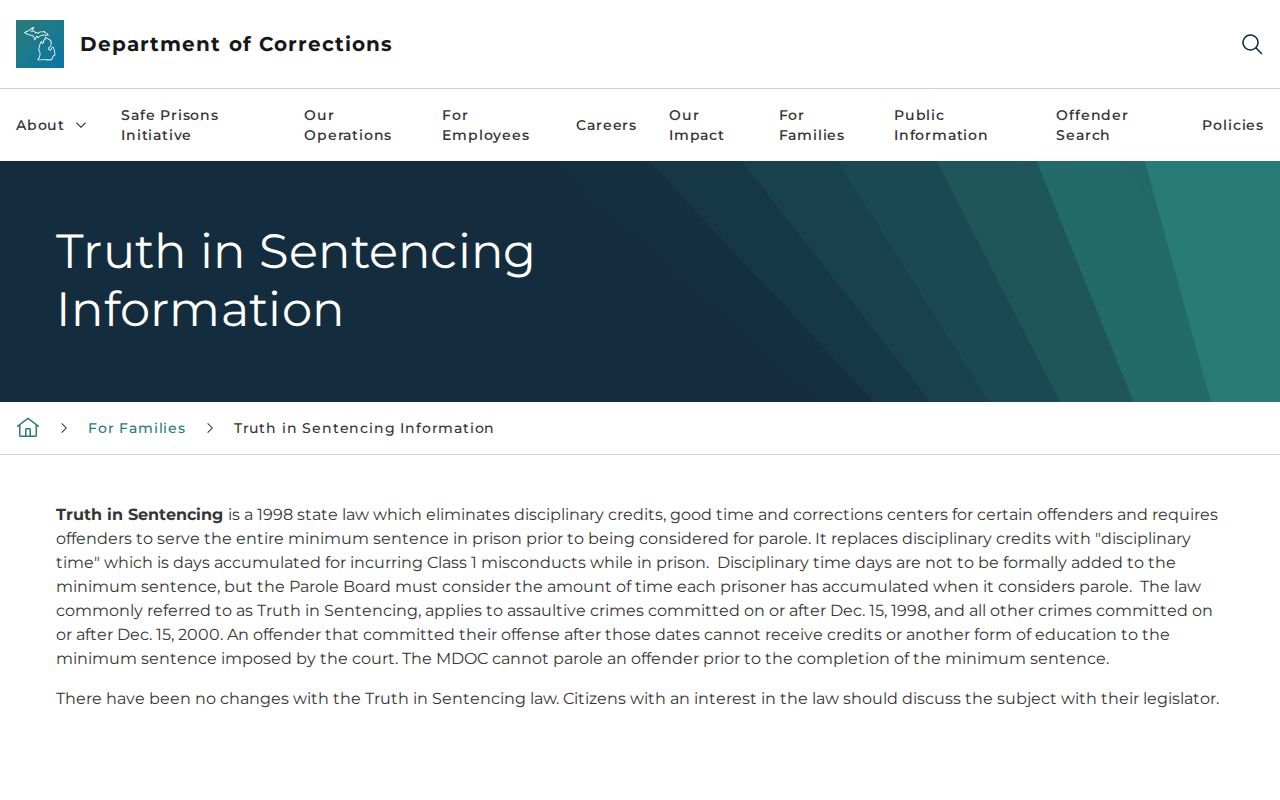
The state source supports a case-specific calculation rather than a flat percentage estimate.
Saginaw Correctional Parole Supervision
A person paroled from SRF remains in MDOC legal custody. OTIS may show the Current Status as Parolee and list an assigned field location. The Region 5 directory lists the Saginaw parole office at 1835 Treanor Street, Saginaw, MI 48601, with telephone 989-754-8661. Probation uses a different office and should not receive a parole inquiry.
Conditions and the Parole Board order control the supervision term. A later Discharge Date can mark successful completion or another final disposition. An absconder status is not discharge. OTIS labels parole and probation absconders separately because the responsible authority and warrant path differ.
Reentry work at SRF occurs before release. Its ReEntry In-Reach designation does not prove that any named person has been granted parole, completed release processing, or discharged. Use the person's record for that conclusion.
Saginaw Correctional Parole Decisions
The Michigan Parole Board is the sole paroling authority for felony prisoners committed to MDOC. Reaching the minimum term gives the Board jurisdiction when the law permits. It does not create a right to leave prison. A panel may grant parole, deny it, defer review, or later suspend or rescind a grant before release if new misconduct or adverse information changes the case.
Michigan does not publish one complete calendar or named-person results database for all routine parole interviews. Public hearings appear as individual MDOC press releases when the law calls for one. Aggregate grant, deny, and defer figures appear in quarterly legislative reports, but those totals do not confirm the outcome for one SRF prisoner. For a named person, use OTIS, an authorized notice, the Parole Board order, or a releasable MDOC record.
A grant and a physical release are also separate events. Placement approval and release processing follow the Board action. The person remains confined until MDOC carries out the release, and a custody record should show the actual Date Paroled.
Saginaw Correctional Record Retention
OTIS generally keeps a discharged profile public for three years after the latest MDOC discharge. A later no-result can therefore reflect the public display rule or a qualifying set-aside. It does not prove the person was never confined at SRF or never served an MDOC term.
After an OTIS profile ages out, the state commitment file and the sentencing court remain the historical paths. Ask MDOC for a discharge certificate or other releasable sentence record, and obtain the judgment or register of actions from the court. A court-derived error should be corrected through the sentencing court. A parole, probation, assigned-office, or absconder error belongs with the supervising MDOC field office.
Saginaw Correctional Facility History
SRF opened in 1993. MDOC describes a 43-acre prison on a 142-acre site with several residential and program buildings. Those facts help distinguish the state prison from Saginaw County Jail, which is operated by the Sheriff and serves a different custody system.
This image from the official MDOC Saginaw Correctional Facility page identifies the correct state institution and contact source.
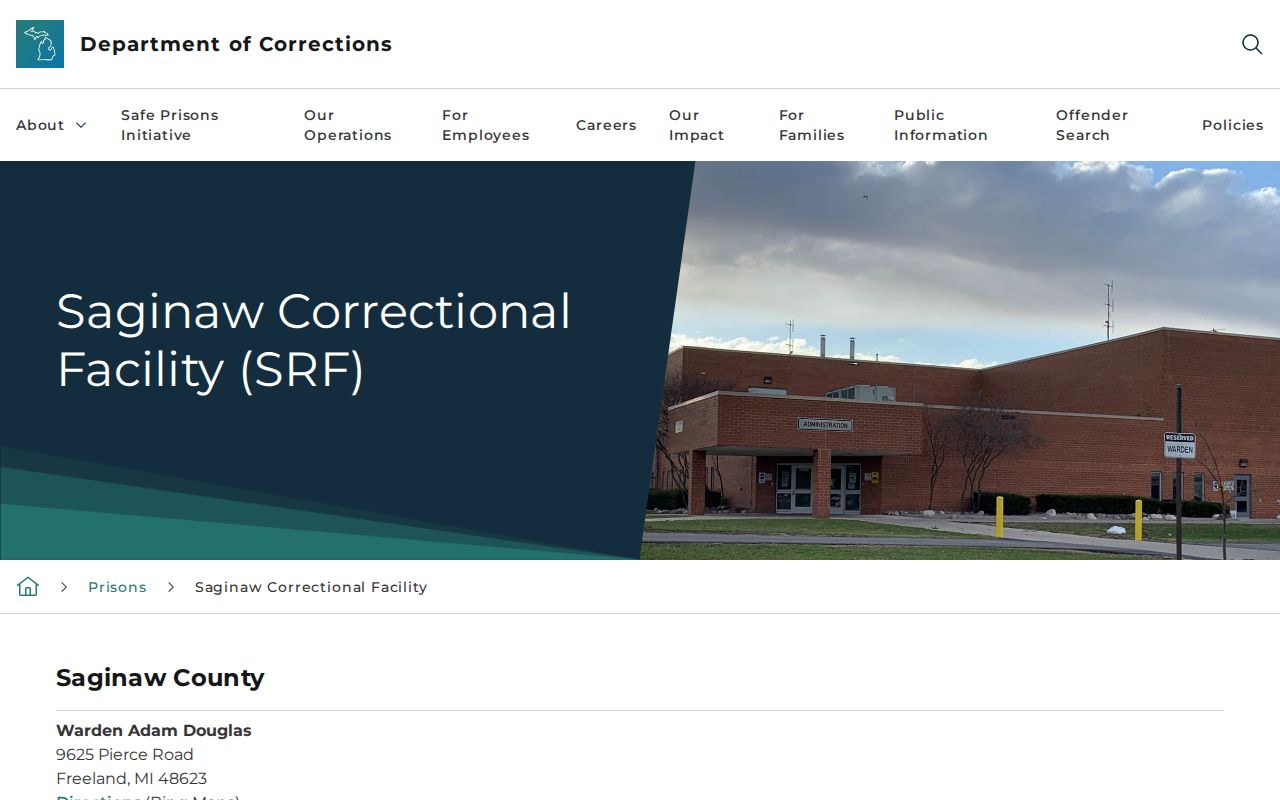
The facility page describes the prison. OTIS and MDOC records, not the facility description, establish a specific parole or discharge.
Saginaw Correctional Release Contact
The prison is located at 9625 Pierce Road in Freeland. The facility telephone is 989-695-9880, and MDOC lists mdoc-saginaw-public@michigan.gov for general questions. Operational staff should not be expected to replace OTIS or provide protected case details.
9625 Pierce Road
Freeland, MI 48623
989-695-9880
mdoc-saginaw-public@michigan.gov
For a current prisoner, use OTIS and the facility contact. For a parolee, use OTIS and the assigned field office. For final discharge proof, use OTIS plus MDOC records. The Saginaw County released inmates search explains how those state records differ from county-jail and federal releases.
Facility staff can confirm public operational details, but the state record remains the release source. If OTIS, a court entry, and a family report differ, record each date and exact label, then ask MDOC which order and custody event currently control.